Introduction
Surface plasmon resonance instruments provide a wealth of information — kinetics, affinity, and concentration. However, one must be mindful that the type of experimental setup can affect the type of data obtainable. There are two types of setup, each designed to perform either steady-state or kinetic measurements.
Steady-state measurements can be achieved via manual injection to obtain affinity data, whereas kinetic analysis requires a pump to determine both kinetic and affinity data. The resulting sensorgrams appear differently as well. This post explains the differences between manual injection mode and pump-assisted mode, and when to use each.
Download Tech Note — Manual vs Pump-Assisted SPR (PDF, 409 KB)Basic Principles of Kinetics and Affinity
In an SPR experiment, ligands (L) are immobilized onto the sensing surface and introduced to an analyte (A). If A has affinity for L at a 1:1 ratio, one can assume a Langmuir binding model:
L + A ⇌ LA (ka, kd)
Here, ka (M−1 s−1) is the association rate constant and kd (s−1) is the dissociation rate constant (also known as kon and koff, respectively). The dissociation equilibrium constant KD — the point at which half of the surface-immobilized ligands are bound to analytes — can be expressed in terms of the free concentrations of analyte [A], ligand [L], and analyte-ligand complex [AL], and also directly from the rate constants:
KD = [L][A] / [AL] = kd / ka
A sensorgram has three main regions used in both steady-state and kinetic experiments. The manual injection mode (steady-state) uses the association region (A) and steady-state plateau (B) to obtain affinity data only. The pump mode (kinetics) uses the association and dissociation phases (A and C) to obtain both kinetic and affinity data.
Manual Injection Mode for Steady-State Measurement
In manual injection mode, samples are injected into the SPR instrument via syringe. Steady-state measurements involve observing equilibrium binding — where the net rate of binding is zero — as a function of analyte concentration, to determine KD.
A typical experiment involves injecting a series of increasing analyte concentrations (at least 5 concentrations) and allowing the sample to remain in contact with the sensor surface until the binding curve levels out (steady state). Note that there is no dissociation phase, since steady-state conditions must be met and there is no flow. The SPR response at steady-state is then plotted against analyte concentration to generate a binding isotherm, and KD is determined by fitting that curve to the steady-state equation.
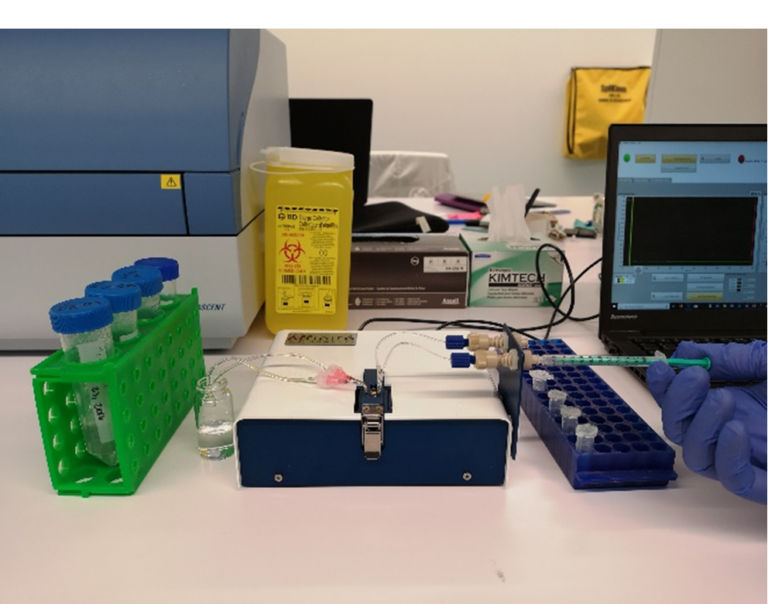
Pump-Assisted SPR for Kinetic and Affinity Data
A pump is required for kinetic measurements because a continuous flow must be provided to observe the dissociation phase following sample injection. A peristaltic pump is connected to the SPR instrument to deliver sample and running buffer in sequence.
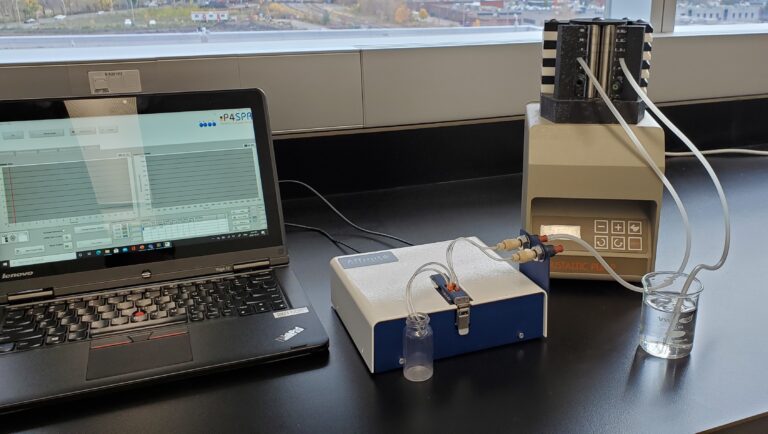
Once the sensorgrams are collected, the association phase is fitted with a suitable binding model — usually a 1:1 Langmuir model (single exponential) — to obtain ka. The dissociation phase is then fitted with a single exponential decay model to find kd. KD is then calculated as KD = kd / ka. The steady-state plateau is not observed in kinetic analysis because running buffer is introduced before the analyte-ligand interaction reaches equilibrium, forcing dissociation.
Multi-Cycle vs. Single-Cycle Kinetics
Kinetic analysis can be performed in two ways:
Multi-cycle kinetics — one analyte concentration is injected to provide one complete sensorgram, followed by a regeneration step. A new concentration is then injected for the next sensorgram, and so on until all concentrations are run. At least 5–8 concentrations are recommended.
Single-cycle kinetics — multiple analyte concentrations (usually low to high, up to 5 concentrations) are injected within the same cycle with no regeneration steps in between.
In both cases, it is recommended to use a range of concentrations centered around the expected KD (from 0.1 to 10 × KD) to eliminate artifacts due to concentration dependency when fitting to a binding model. Other considerations for kinetic measurements include the requirement for more sample volume and the potential for mass transfer effects at high analyte concentrations.
Comparison Summary
| Manual Injection | Pump-Assisted | |
|---|---|---|
| Measurement type | Steady-state | Kinetic |
| Data obtained | KD (affinity) | ka, kd, KD (kinetics + affinity) |
| Flow | No continuous flow | Continuous flow required |
| Dissociation phase | Not observed | Observed and fitted |
| Sample volume | Low | Higher |
| Equipment needed | Syringe only | SPR instrument + pump |
| Mass transfer effects | None | Possible at high concentrations |
| Portability | Maximum — no accessories required | Reduced — pump required |
Besides the type of data needed, factors such as cost, sample volume, time, and portability all influence which setup is most appropriate for a given experiment.
The P4SPR™ — Built for Both
Affinité Instruments designed the P4SPR to accommodate both steady-state and kinetic measurements. Syringes can be used to inject samples directly into the instrument for manual mode. For kinetic analysis, a peristaltic pump or a compatible injection loop module can be integrated to deliver samples under continuous flow. The same instrument, two measurement modes.
Contact us to learn more about SPR at [email protected].
References
- P. Anton van der Merwe, "Surface Plasmon Resonance," in Protein-Ligand Interactions: hydrodynamics and calorimetry, Oxford University Press, 2001. Link